Grammar
Forgive me about my perfections.
Table of Contents
I’m really a strict person when talking about the grammar used in the API. Even, for trivial things like the page slug that you see in the address bar would also have to be arranged carefully. My background that was not originally be born from a native English speaker mother makes me to learn English a lot. Though, my English is really not as casual as native English people are, but at least I am concerned with the consistency of the API.
Command
My first thought previously was trying to list all commands that possibly can be used globally by the classes. Then, I thought about the computer commands. In a computer, we have common API that consists of three or four commands. They are create, update, delete, and open. Even, the PHP itself also has some built-in methods like __set(), __get(), __isset() and __unset(). From that, I can then make an overview of the verbs which possibly can be used as the API:
| Create | Delete | Open |
|---|---|---|
| | clear | |
| + | - | = |
| add | remove | has |
| construct | destruct | |
| create | destroy | |
| install | uninstall | run |
| launch | abort | |
| mount | unmount | |
| plug | eject | |
| plug | unplug | |
| post | | get |
| push | | pull |
| send | | retrieve |
| set | unset | get |
| submit | cancel | |
| upload | unload | download |
| write | erase | read |
Some of the groups are missing their parts. But I have to use at least three verbs for perfect commands, so I cancel all of the incomplete groups.
The next step is choosing the candidate. There are some rules:
- As short as possible
- Use single word where possible.
Words like upload, unload and download are seemingly be constructed by two words with load as the base command: up·load, un·load and down·load. So I cancel this option. add, remove and has are good, but using has to open something seems improper. So I cancel this option too. write, erase and read are good and indeed look very standard for a file-based CMS, but they are not universal. What if we want to use this API for doing like creating or getting an image. We normally does not write and read images, but draw and capture.
I need the universal one, and then decided to use set, unset and get because they are the shortest, and can be used as a valid object key.
There is a problem with the unset word. I can’t use that because it is constructed by two words: un·set. Then I try to choose another alternative and found reset. reset also seems to be constructed by two words: re·set. But I can’t remember that I ever found other words that can be freely combined by the re like these. Even if they can, they are uncommon:
| Create | Delete | Open |
|---|---|---|
| re·add ✔ | re·remove ✘ | re·has ✘ |
| re·launch ✔ | re·abort ✘ | |
| re·set ✔ | | re·get ✘ |
| re·write ✔ | re·erase ✘ | re·read ✔ |
I can find reset as a word but not with unset:
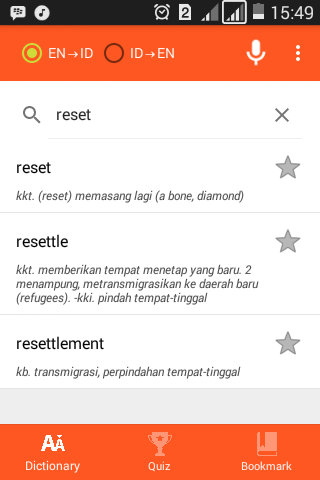
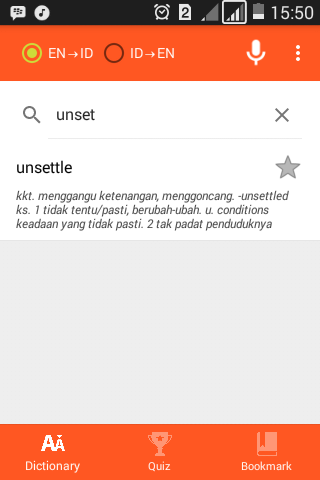
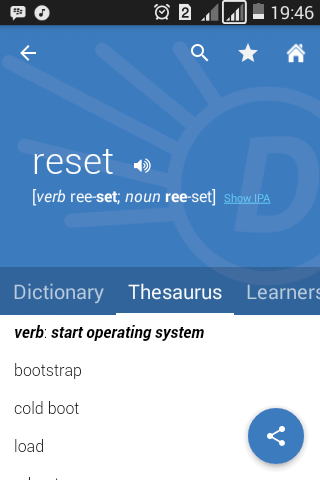

The word reset may can’t represent all of the delete command but at least people can quickly understand with the meaning of reset as start over, back to zero or back to initial, which can also means becomes null, just like the default value of every variable with no values set. We can use, for example, write, erase and read if set, reset and get seem improper to be used just like what I did for the File
class Common extends Genome {
    public function set() {}
    public function reset() {}
    public function get() {}
}By standardizing the commands, I hope people can learn and understand faster because they can easily guess what methods are contained on every standard class.
Plural and Singular
Other things that disturb me a lot is the plural and singular nouns. I can’t standardize these things because there are some words that simply can be suffixed with an s to make it becomes the plural noun version, and some of them need to use es or need to change the last y part into an i just before doing the es thing. Some of them also cannot be pluralized because they already can be treated as a plural or singular noun by itself, or because they have their own plural word version. Here are some examples:
| Singular | Plural |
|---|---|
| category | categor[y,ies] |
| child | child[ren] |
| data | data |
| datum | data |
| kin | kin |
| page | page[s] |
| person | people |
| sibling | sibling[s] |
| status | status[es] |
| tag | tag[s] |
That’s why I stopped doing something like naming the folder or classes with plural noun:
.\
├── engine\
│   ├── kernel\
│   │   ├── hook.php
│   │   ├── language.php
│   │   ├── message.php
│   │   ├── page.php
│   │   └── …
│   ├── plug\
│   │   └── …
│   ├── f.php
│   └── fire.php
├── lot\
│   ├── asset\
│   │   └── …
│   ├── cache\
│   ├── extend\
│   │   ├── …
│   │   └── plugin\
│   │       ├── engine\
│   │       └── lot\
│   │            ├── …
│   │            ├── art\
│   │            └── markdown\
│   ├── page\
│   │   └── …
│   ├── shield\
│   │   ├── …
│   │   └── document\
│   └── state\
│       └── config.php
├── .htaccess
├── favicon.ico
├── index.php
└── LICENSE
[connect:../reference/file]
In the file tree above, you can see that I have an extend folder which is still problematic for me. Why? Because extend is actually a verb, not a noun!
Then why don’t you use the word extension from the start?
That thing was a mistake, I think? But, the word extend just stuck in there and looks familiar just the way it is, so maybe I will treat the word extend as a noun in this case, so that we can say extends in place of extensions to represent a group of extensions?
Or… maybe I can replace the extension folder name with a word that has no meaning at all like x to represents extension?
But, but, we already have an automatic constant creation based on the folder name, and X is already defined as a constant to represents universal placeholder character.
Oh, oh, wait! But it will not redefine itself if it is already defined! So, we can hard-code the .\lot\x path value into an EXTEND constant. Yes, this is a GOOD idea!
.\
├── engine\
└── lot\
    ├── asset\
    ├── cache\
    ├── language\
    ├── page\
    ├── shield\
    ├── state\
    └── x\
OMG. No.
And, then, to overcome the limitation on distinguishing between the plural and singular, I have created the ability to use the thing as a plural or singular thing by using only the singular thing. For example, we can process single hook or multiple hooks with a single Hook
Hook::set('foo', function($content) { … });
Hook::set(['foo', 'bar', 'baz'], function($content) { … });

Hook::reset('foo');
Hook::reset(['foo', 'bar', 'baz']);

Hook::fire('foo', [$content]);
Hook::fire(['foo', 'bar', 'baz'], [$content]);
So that we can avoid on making the plural class name like this:
Hook::set('foo', function($content) { … });
Hook::reset('foo');
Hook::fire('foo', [$content]);

Hooks::set(['foo', 'bar', 'baz'], function($content) { … });
Hooks::reset(['foo', 'bar', 'baz']);
Hooks::fire(['foo', 'bar', 'baz'], [$content]);
Tenses
Inspired by the AJAX things, I divided the commands mostly into three states: present, present continuous and past tense. This is what I mean:
| Present | Present Continuous | Past |
|---|---|---|
| back up | backing up | backed up |
| close | closing | closed |
| create | creating | created |
| delete | deleting | deleted |
| log in | logging in | logged in |
| open | opening | opened |
| publish | publishing | published |
| save | saving | saved |
| send | sending | sent |
| update | updating | updated |
But, as the plural and singular things, they are also can’t be standardized. Some of the verbs can be suffixed by an ing and ed but some of them can’t. Some of them need to remove the last e and i part just before doing the ing and ed thing. Some of them need to double the last part just before doing the ing and ed thing. Some of them are not a valid language form and thus can’t be appended with the ing and ed things anyway. Words like backup and login are two examples of invalid term, but they are already used globally on the web and actually constructed by two words: back·up and log·in. That’s why we can’t say backuping and logining. Instead, we have to say backing up and logging in.
But, for the sake of consistency, I have standardized these thing away into a broken English grammar only for the language key. You can then set the proper grammar in the value side. This also applies to the noun. The rules are:
- Append an s to the key to make the plural version of the noun
- Append an ing to the key to make the present continuous version of the verb
- Append an ed to the key to make the past version of the verb.
backup: Back Up
backuping: Backing Up
backuped: Backed Up

category: Category
categorys: Categories

child: Child
childs: Children

close: Close
closeing: Closing
closeed: Closed

kin: Kin
kins: Kin

open: Open
opening: Opening
opened: Opened

page: Page
pages: Pages

save: Save
saveing: Saving
saveed: Saved

tag: Tag
tags: Tags
This way, we can easily tell the engine which part is the singular, which part is the plural, or which part is the present command, which part is the present continuous command and which part is the past command simply by detecting the end of a string:
echo $i . ' ' . $language->{'comment' . ($i === 1 ? "" : 's')};echo $language->{'save' . Anemon::alter($status, [
1 => 'ing',
2 => 'ed'
], "")};Update: This feature has been removed.
46 Comments
HildaLot
Довгий час була впевнена, що відмінно вмію готувати, але недавно мої страви стали скучними і почали повторюватись. Дівчина запропонувала мені переглянути оригінальні рецепти, але я не знала, де шукати. Випадково в інтернеті знайшла цей каталог і... це було як відкриття нового світу! Оказалося, що є безліч сайтів з незвичайними рецептами, про які я навіть не підозрювала. Я була в захваті від розділи з фірмовими стравами та рецептами національних кухонь. Протягом місяця я освоїла страву французької кух
KeliFluth
Завжди вважала, що чудово вмію готувати, але недавно мої страви стали скучними і втратили різноманітність. Подружка підказала мені ознайомитись нові рецепти, але я не знала, як підібрати. Випадково в інтернеті знайшла цей каталог і... це було наче знахідка скарбу! Я дізналася, що є цілий океан сайтів з незвичайними рецептами, про які я навіть не здогадувалася. Я була в захваті від підбірки з фірмовими стравами та рецептами різних кухонь світу. За цей час я спробувала страву французької кухні, тайської т&#
Brensnaph
Вибачте, але я мушу поділитися кулінарною драмою, що виникла у мене минулого тижня – уявіть собі!. Моя мала вимовила бажання, щоб як кулінарний експерт спекла дещо неймовірно красиве до її ДР. Я, як завжди, безумовно, почала переглядати врятувальну знахідку у Google і отримала несподіванку. Провела аж півтора години, і це ще щастя!, мов зомбі від блогу до черговий кулінарний портал! Одні рецепти були занадто заплутані, інші - з дивними компонентами, решта - серед тоннами реклами. А згодом ваша героїня згадала щод
AnthonyFum
WinLion Casino is an up-to-date, integrated platform created with Canadian players, combining over 9,000 games alongside a full sportsbook. Thanks to its sleek design, smooth mobile experience, and attractive bonuses, it’s quickly making a name for itself. You can check out the site here: https://winlioncasino.com/
Bonuses & Promotions
New players at winlion casino can grab a welcome package stretched over their first four deposits, giving up to $1,500 in bonus funds and 240 free spins with a 40x wagering requirement. Regular players get weekly reload bonuses, up to 10% cashback on net losses (often with zero playthrough requirements), and a multi-level loyalty program that rewards you with faster withdrawals and a personal account manager. You can log in to view your progress here: https://winlioncasino.com/logins/
Games & Betting
With over 9,000 titles from top studios like Pragmatic Play and NetEnt, winlion casino canada showcases exceptional variety. Slots span classic fruit machines to Megaways and progressive jackpots. The live casino showcases roulette, blackjack, and game shows like Crazy Time in high definition. The sportsbook delivers deep hockey coverage combined with other sports and esports, with live betting and cash-out options.
Banking & Mobile
Winlion accepts Canadian dollars (CAD) and provides fast transactions via Interac, credit cards, e-wallets, and crypto. Withdrawals to e-wallets and crypto are commonly processed within 24 hours. The platform uses a Progressive Web App (PWA) that enables you to install the site to your phone’s home screen for a smooth, app-like experience with no need to download anything.
Support & Final Thoughts
24/7 live chat and email support are accessible, along with responsible gaming tools like deposit limits and self-exclusion.
Pros: Generous welcome package, vast game library, Canada-friendly banking with Interac and CAD, fast withdrawals, smooth mobile PWA, and a full sportsbook with live betting.
Cons: Anjouan license can be less familiar to some players; no traditional 2FA.
For Canadian players looking for a versatile platform that handles casino games and sports betting with consistent polish, winlion casino canada is truly worth a closer look.
Brendscumb
Хочете знайти надійні українські медіа? Завітайте на hiobzor.space – на цьому сайті розміщений свіжий перевірений список українських медіа. Об'єктивність, оперативність та різноманіття поглядів – головні критерії відбору. На ресурсі представлені як регіональні видання (Ізюм, Кривий Ріг, Чернівці), так і загальноукраїнські агентства з розслідуваннями, аналітикою та ексклюзивними матеріалами. Обирайте своє джерело новин разом з hiobzor.space!
Jefeydrymn
Обнаружил удобный сайт — аккуратный путеводитель надёжных новостных и аналитических медиа Украины. Имеет название «медіа-путівник». Ресурс не претендует на роль СМИ, а всего лишь собирает ссылки на местные и профильные независимые издания.
Сам каталог доступен по ссылке: aeguewquweef.space.
Главная страница содержит ряд изданий с лаконичным описанием:
Samuelsmach
Хочу рекомендувати важливою інформацією для усіх, хто має кішок. Сайт https://iommy-mummy.space/ надає інформацію про виховання кішок. На сайті ви знайдете багато цікавих та корисних статей, наприклад:
Як розвиваються кошенята в перші тижні життя. Як вчинити, коли кішка ігнорує кошенят. Вся інформація підкріплені картинками, що робить їх сприйняття простішим для розуміння. Сайт буде корисним як для досвідчених власників кішок. Раджу відвідати! Ви можете поділитися корисні поради, поділіться ними в коментарях
Richardtoota
Натрапила на якусь сторінку — ououpoh.space. Якщо чесно, не одразу збагнеш, на чому він спеціалізується. Адреса виглядає незвично, однак оформлення мінімалістичне. Наповнення зараз мізерне, скидається на експеримент або особистий блог. Хтось у курсі, хто автор? Поділіться думками, якщо вже там були
LarryRic
На цьому сайті зібрані унікальні матеріали та рішення, які допоможуть вам швидко знайти потрібну інформацію
Тут ви знайдете як практичні поради, так і цікаві факти з різних сфер життя
Коли потрібна потрібна інформація, загляньте на owuiehoiwerg.space — там зібрано все найважливіше для кожного дня
LewisLiaps
Тут представлені провідні українські новинні видання — від регіональних новин до наукових публікацій.
Тут зібрані свіжі новини про події в Києві, Харківській області, наукові публікації НАН України, актуальні економічні та суспільні новини.
Добре підходить для тих, хто цінує якісну інформацію, але не хоче шукати інформацію на різних сайтах.
Завітайте та отримуйте актуальну інформацію зручно!
TerreElomy
Колеги форумчани, натрапив зручний збірник якісних новинних джерел. На ресурсі powejhphweroihr.space представлено 6 самостійних українських видань. На ресурсі є місцеві ЗМІ Кіровоградщина, Чернівці, сайти про енергетику «iEnergo», «Gelios», освіту «Вісник НАНУ» та суспільно-політичний ресурс «ПравдаТут». Кожен із них доповнюється стислим поясненням фокусу: факти, аналітичні матеріали, журналістські розслідування, тарифи. Жодної нав'язливої реклами – виключно список актуальних медіа. Корисна основа для кого цікавиm
DavidRup
newobzor.space — це український каталог, який об'єднує найкращі новинні сайти країни. Тут ти знайдеш надійні інформаційні ресурси, де публікуються актуальні новини, експертні матеріали та ключові події з України та світу.
На сайті представлені:
Якщо тобі важливо отримувати інформацію з надійних джерел, каталог newobzor.space стане чудовим помічником!
Georgeovalp
Підбірка надійних українських медіа без зайвого шуму. В добірці — виключно перевірені ресурси:
Жодної політичної заангажованості, тільки перевірені дані, місцеві події, розслідування та академічні матеріали.
Ось посилання: poiqkljhd.space
Підходить для щоденного моніторингу новин. Збережіть собі та перешліть тим, хто потребує достовірну новини.
ShawnArren
На сайті kjskjbsdklksasdfh.space ви знайдете цікаву інформацію, новини та інтуїтивний інтерфейс. Тут зібрано все, що потрібно знати активним користувачам: від статей до рекомендацій. Відвідайте та переконайтеся в його якості на власні очі!
MatthewRem
Недавно наткнулся на сайт pewhiweoiuwegouwegf.space и решил оставить отзыв.
Сервис сразу притягивает внимание своим нестандартным названием и вызывает любопытство сразу после входа.
По первому знакомству проект выглядит как сайт, сделанный в стиле на упрощённую подачу информации и минималистичный стиль.
Не лишним будет отметить, насколько удобно здесь ориентироваться, насколько динамичной выглядит работа, и понятно ли, что именно он предлагает.
Что стоит обсудить в первую очередь: Общую концепцию и за&
Cesarner
Недавно нашёл сайт louewqiuegiuewoo.fun и решил поделиться своими мыслями.
Ресурс сразу бросается в глаза своим нестандартным названием и привлекает интерес ещё при первом посещении.
На первый взгляд проект выглядит как площадка с упором на лаконичную подачу данных и минимализм.
Важно отметить, насколько понятна навигация, насколько отзывчивый сайт, и понятно ли, зачем вообще создан сайт.
Что стоит рассмотреть в первую очередь: Основную идею и направление ресурса. Удобство интерфейса. Во́нкальный ви
CarlosDob
На сайті qpoaswap.space ви виявите актуальну інформацію, публікації та простий інтерфейс. Тут зібрано все, що може зацікавити активним користувачам: від оглядів до лайфхаків. Перейдіть та оцініть в його ефективності особисто!
RobertUrine
На сайті opppalldh.space ви отримаєте цікаву інформацію, новини та простий інтерфейс. Тут зібрано все, що стане в нагоді активним користувачам: від публікацій до рекомендацій. Заходьте та переконайтеся в його ефективності на власні очі!
RonaldRap
Шановні форумчани! Коли ви плануєте будівництво, ремонт або хочете оновити інтер'єр, то ситуація знайома багатьом: доводиться шукати інформацію по крихтах на десятках сайтів. А як чудово, коли всі потрібні сайти зібрані докупи. Власне, для цього й існує ресурс olouiiifuyfdds.space, на якому представлено добірку якісних сайтів рідною мовою.
Ось що там є:
ElmerSic
Сайт pwpepwetf.space — це український підбірка, який представляє найкращі новинні сайти країни. Тут ти знайдеш перевірені джерела, де публікуються офіційні новини, експертні матеріали та важливі події з України та світу.
На сайті представлені:
Якщо тобі необхідно отримувати інформацію з перевірених ресурсів, каталог pwpepwetf.space стане надією на якісну інформацію!
Henryroppy
Сайт ktozoveta.space — це український каталог, який об'єднує найкращі новинні сайти країни. Тут ти знайдеш перевірені джерела, де публікуються актуальні новини, експертні матеріали та ключові події з України та світу.
На сайті представлені:
Якщо тобі важливо отримувати інформацію з надійних джерел, каталог ktozoveta.space стане надією на якісну інформацію!
BarryTAF
Сайт eoooirm.space — це український збірка, який представляє найкращі новинні сайти країни. Тут ти знайдеш перевірені джерела, де публікуються офіційні новини, аналітика та ключові події з України та світу.
На сайті представлені:
Якщо тобі важливо отримувати інформацію з перевірених ресурсів, каталог eoooirm.space стане чудовим помічником!
Jesusoceat
loasoiwyef.space — це український каталог, який збирає та систематизує найкращі новинні сайти країни. Тут ти знайдеш надійні інформаційні ресурси, де публікуються актуальні новини, аналітика та важливі події з України та світу.
На сайті представлені:
Якщо тобі необхідно отримувати інформацію з надійних джерел, каталог loasoiwyef.space стане надією на якісну інформацію!
ChaelHoogs
Мы делаем сайты, которые привлекают клиентов и увеличивают продажи.
Почему стоит выбрать нас? Креативный дизайн, который удерживает взгляд Адаптация под все устройства (ПК, смартфоны, планшеты) SEO-оптимизация для продвижения в Google Скорость работы — никаких "тормозящих" страничек
Специальное предложение: Первым 5 заказчикам — дисконт 6% на разработку сайта!
Готовы обсудить проект? Напишите нам! Блог
ChaelHoogs
Мы делаем вебсайты, которые привлекают клиентов и увеличивают продажи.
Почему стоит выбрать нас? Современный дизайн, который удерживает взгляд Адаптация под все устройства (ПК, смартфоны, планшеты) SEO-оптимизация для роста в ПС Скорость загрузки — никаких зависающих сайтов
Специальное предложение: Первым 11 заказчикам — дисконт 7% на разработку сайта!
Готовы обсудить проект? Позвоните нам! Сайт студии 09uyazstart.xyz
Editharbip
Хочу показати вам корисним та зручним проєктом — laeoloef.space — стильним і простим каталогом українських сайтів.
Сайт зроблений дуже чисто, адаптивно і швидко працює.
Інтерфейс зручний, без зайвого сміття, з сучасним дизайном і українською мовою.
Особливо сподобалося: • Повна адаптивність (чудово виглядає на телефоні) • Чистий мінімалістичний стиль • Швидке завантаження • Зручна навігація
Кому треба легко знайти якісні українські ресурси — варто відвідати.
WiiamDes
Чимало людей іноді хоче знайти креативних рішень на кухні, особливо, коли одноманітна їжа стали нецікавими, а на кулінарні витребеньки не вистачає. Якраз тоді виручає сайт, де можна оперативно підібрати слушну ідею під бажання і те, що є в холодильнику. https://celentano-pizza.com.ua/ - celentano-pizza.com.ua зробився для широкого загалу тим самим місцем, куди заходять регулярно, щоб знайти свіжу ідею чи просто переглянути перевірені варіанти.
Веб-сторінка пропонує широкий спектр контенту, від класичних рецептів макаронних виробів до хитрощ&
Ernesttal
Коли день починається з перевірки інформаційної стрічки, багато хто шукає майданчик, де події викладаються без зайвої метушні, але з потрібними деталями. https://ukrenergo.in.ua/ - ukrenergo.in.ua зробився для певної аудиторії саме таким місцем, куди заходять, щоб оперативно дізнатися, що коїться у державі та поза її кордонами, не витрачаючи години на перегляд різних каналів.
Публікації тут здебільшого торкаються тієї проблематики, які мають прямий вплив на буденні справи — починаючи з економічних коливань до питань безпеки. Ч
Rikafag
Многие из нас время от времени запускают браузер в поиске материала, которое не просто убьет время, а оставит после себя мысли и неожиданные осознания. На https://streetmusic.com.ua/ - streetmusic.com.ua именно такой контент такой контент, где переплетаются разборы фильмов, истории музыкантов и заметки о жизни. Материалы написаны так, что читаешь и ловишь себя на том, что воображаешь, как воплощается в аудио или на дисплее.
Портал не гонится новизной каждого абзаца, зато создает впечатление, будто общаешься с единомышленником, который с&
EdwardWah
Коли заходиш на institute.lviv.ua, одразу відчуваєш, як багатство контенту захоплює від перших рядків. Сайт не обмежується однією темою, а змішує історії з культури, практичні поради для дому, відомості про оборону та щоденні турботи. Така комбінація робить його помітним серед інших ресурсів, адже кожному перепаде тут щось близьке саме собі.
Матеріали на https://www.institute.lviv.ua/ - institute.lviv.ua часто починаються з реальних ситуацій, які хвилюють українців сьогодні, і поступово розгортають глибше тло. Такий метод дозволяє не лише повідомлят
RalphSoawn
Нерідко у щоденній метушні бажається знайти джерело, котре зводить докупи важливі факти з оповідями про героїв, чиї долі межують з історією країни. Чимало користувачів підшукують подібний контент, де зведення не ізольовані від людських історій, а натомість вчать повніше відчути картину. Ресурс rodis.org.ua пропонує саме цей підхід, накопичуючи публікації, присвячені оборонних питань, доль публічних людей і їхньої реакції у воєнний період.
Ті, хто стежить за тим, що відбувається та історіями кумирів, деда&#
WilliAdvex
Нинішній інформаційний світ заповнений різними джерелами, де кожен намагається викликати інтерес своєю особливістю. Поміж них plandiy.com.ua виділяється спроможністю висвітлювати події так, наче вони розгортаються просто зараз, без зайвих затримок чи перекручувань. Відвідувачі часто повертаються на цей сайт, тому що відшукують тут гармонійне поєднання між швидкістю і глибиною висвітлення.
Найбільше притягує те, як https://plandiy.com.ua/ - plandiy.com.ua природно об'єднує внутрішні українські теми з світовими тенденціями, даючи 
GregoryGat
Друзі, ненавмисно знайшов на один веб-ресурс. З першого погляду здався пересічний сайт, але я придивився уважніше. Тематики дуже різноманітні: розділи про історію, космос, новини, поради й природу. Виходить, можна і про науку почитати, і про побутові дрібниці.
Для прикладу, прямо зараз на сайті є публікація про святкові традиції і повір'я на 7 травня, а поруч – матеріал про проблеми з роботою Монобанку в 2026 році. І все це зібрано на одному сайті: triada.in.ua
Окремий розділ «Церковні та святкові дні» — також доволі
Gordonaxiow
Коли настає святковий день чи звичайно бажається промовити близькій людині щось тепле, слова іноді ніяк не складаються. Власне в такі моменти добре зазирнути на портал, де зібрано чимало слів, що звучать щиро, без зайвої штучної пафосності. На https://mgk.if.ua/ - mgk.if.ua легко знайти побажання, які доречні і для Нового року, і для Святвечора, і для днів, коли людина потребує слів підтримки у хворобі. Тут матеріали підготовлені так, немов їхні тексти склав той, хто добре знає, наскільки важливо не просто сказати, а справді відд
DouglasPraiz
Багато хто шукає місця, де можна знайти матеріали, що поєднують розвагу з корисними деталями про життя відомих людей чи повсякденні задачі. Саме таким ресурсом стає https://oh.ua/ - oh.ua, де публікують статті, які зачіпають різні сторони людського досвіду. Читачі знаходять тут і глибокі розповіді про акторів, і прості пояснення, як розібратися з головоломками чи зрозуміти себе. Кожен матеріал тримає увагу, бо автор підходить до теми з цікавістю, ніби ділиться знахідкою за кавою.
Сайт постійно оновлюється, і це роб
SteveSpine
Серед потоків інформації, що щодня з’являються в мережі, є ресурси, де матеріали підібрані зважаючи на справжню користь для користувача. Сайт збирає публікації різних типів, від практичних порад до роз'яснень щоденних мовних ситуацій а також психологічних нюансів. Відвідувач знайде тут актуальні новинні дописи, і публікації, що дають змогу розібратися в деталях звичайного життя.
Доречно зазначити, що регулярне звернення до https://mainacademy.ua/ - Main Academy допомагає швидко орієнтуватися у великій кількості питань, як&#
RecepGaddy
Майданчик https://mulkarecepka.space/ - mulkarecepka.space — це зручна добірка відібраних рецептів страв призначених для мультиварки. Тут відсортовані рецепти для конкретних програм: плов, каші, перші страви, гасіння, хліб та пироги, пароварка, кисломолочні продукти. Усі рецепти супроводжується вивіреною кількістю продуктів, час приготування та підказки-поради, для того щоб нічого не пригоріла і не розварилася. Також є короткі поради по догляду і зведена таблиця з приблизним часом приготування найпоширеніших продуктів. Сайт зробле
Nashedem
Видання nashesiaivo.space є українськомовний онлайн-журнал про відомих особистостей, світ шоу-бізнесу та мистецьке життя.
На ресурсі виходять інтерв'ю з відомими акторами, свіжі новини знаменитостей, розслідування зіркових історій, огляди про музичну індустрію, кіноіндустрію, світ моди і стиль. Актуальні теми — бесіди з музикантами, очікування нагород, огляди реаліті-шоу і повернення артистів. Представлені найкращі матеріали тижня, свіжий номер та доступна опція підписатися на дайджест.
Коротко й по
Ashleinisp
Майданчик pivnichnyiazymut.space — український електронний журнал з точними порадами на життєві питання.
Тут публікують тексти про кулінарію, здоров'я, садівництво та городництво, побутову техніку, красу, ментальне здоров'я та життєписи знаменитостей. У переліку тем — як довго зберігати продукти, оформлення лікарняних, обрізка винограду, догляд за обличчям, поради при вигоранні. Без зайвих слів — тільки конкретні й ефективні підказки.
Зручне місце для людей, що шукають прості відповіді на домашні й нагальн
oleh_hibiscus
«Моя квітка» — видання про квіти й рослини в реальному домі та саду. Не вітрина букетів і не загальний гід «як поливати все підряд». Йдеться про те, як розпізнати вид, посадити, змусити цвісти і не вбити зелень типовими помилками: залив, тінь не в той бік, «китайська троянда», яка насправді гібіскус.
Редакція не збирає факти «на ефект». Беруть конкретну рослину — ранункулюс, адоніс, гвоздику, орхідею, заміокулькас, бокарнею — і розкладають її по будові, світлу, ґрунту й поливу. Принцип простий: якщо після тексту можна самому звірити латинську назву, режим і типову помилку і зрозуміти, чому не цвіте, матеріал зробив свою роботу.
На сайті є догляд за кімнатними рослинами, посадка садових квітів, шкідники на кшталт павутинного кліща і короткі пояснення, як обрати букет без зайвих обіцянок. Поруч — не «магія цвітіння», а світло, вода, ґрунт і те, що вже видно на підвіконні. Мова спокійна, без води й гарантій пишного цвіту за тиждень.
Якщо треба не ще один список лайфхаків, а розібратись у конкретній квітці, варто почати звідси: moyakvitka.com.ua
maksym_kozerog
«Зоряний компас» — видання про гороскопи, таро й нумерологію простими словами. Не стрічка «вам пощастить» і не збірка туманних пророцтв. Йдеться про знак на сьогодні, місячний календар, китайський зодіак, значення імені, рівнодення і те, що з цього можна перевірити в календарі, а не лише в відчутті.
Редакція не збирає факти «на ефект». Беруть конкретне питання — який сьогодні день у місячному календарі, що означає рік Вогняного Коня, як визначити високосний рік, що ховає ім’я — і розкладають його спокійно. Принцип простий: якщо після тексту можна самому звірити дату, знак і формулювання і зрозуміти, про що саме йдеться, матеріал зробив свою роботу.
На сайті є щоденні гороскопи для 12 знаків, місячні календарі, нумерологія імен, китайський зодіак і короткі пояснення снів чи вибору після рівнодення. Поруч — не гарантія долі, а день, знак і зміна, яку варто помітити. Мова спокійна, без води й гучних обіцянок.
Якщо треба не ще один гороскоп «для всіх», а розібратись у даті й знакові, варто почати звідси: mojazirka.com.ua
oksana_kyivfact
«Між іншим» — видання про те, про що не встигли розповісти в школі. Не загальнонаціональна стрічка і не збірка курйозів. Йдеться про дати, імена, рішення і факти, які часто живуть у чатах як скріншот: коли реєстрація на НМТ, хто стоїть за прізвищем у стрічці, що саме сказали на переговорах, чим Київ відрізняється від стереотипу.
Редакція не збирає факти «на подив». Беруть питання — реєстрацію іспиту, біографію, економію в побуті, заяву влади — і розкладають його по джерелах і контексту. Принцип простий: якщо після тексту можна самому знайти ту саму дату, прізвище чи формулювання і зрозуміти, де кінчається чутка, матеріал зробив свою роботу.
На сайті є пояснення про навчання і правила, про людей, чиї імена спливають у новинах, про міста поза звичними листівками і про те, як великі рішення доходять до звичайного дня. Поруч — не «треба знати всім», а конкретна цифра, строк і зміна, яку варто перевірити. Мова спокійна, без води й гучних обіцянок.
Якщо хочеться розібратись у факті, а не прочитати ще один заголовок, варто почати звідси: faktoteka.com.ua
serhiy_slovyanskyj
«Володимирська брама» — видання про головне з життя міста Володимира і Волині. Не загальноукраїнська стрічка і не туристичний гід «княжим містом». Йдеться про міськраду, водоканал, місця біля парку, місцеві втрати і зміни, які вже стосуються вулиці, колодязя чи ринку.
Редакція не збирає факти «на ефект». Беруть подію — прийом заявок до 28 вересня, роботу водоканалу, офіційне підтвердження загибелі володимирчанина, рішення громади — і показують, що саме зафіксовано і звідки це відомо. Принцип простий: якщо після тексту можна самому знайти те саме оголошення міськради чи служби і зрозуміти, кого воно стосується в місті, матеріал зробив свою роботу.
На сайті є новини Володимира й Волині, матеріали про воду і самоврядування, короткі практичні пояснення і те, що змінюється в місті на конкретну дату. Поруч — не лозунги про «древню столицю», а строк, адреса і служба. Мова спокійна, без води й гучних обіцянок.
Якщо треба не «новини взагалі», а що відбувається у Володимирі насправді, варто почати звідси: volodymyrskyy.com.ua
yaroslav_troieshchyna
«Київський квартал» — видання про новини Києва та області. Не загальноукраїнська стрічка і не гід центром. Йдеться про райони, маршрути автобусів і трамваїв, ДСНС, укриття, школи, тарифи, кримінальну хроніку і те, що вже змінилось у конкретній громаді Київщини.
Редакція не збирає факти «на гучність». Беруть подію — дозвіл повернутися в оселі у Вишневому і Милій, графік трамваїв 14 і 15, повернення коштів у «Київ Цифровий», відстрочку для студентів — і показують, що саме зафіксовано і звідки це відомо. Принцип простий: якщо після тексту можна самому знайти те саме повідомлення КМДА, ДСНС чи перевізника і зрозуміти, якого маршруту чи району воно стосується, матеріал зробив свою роботу.
На сайті є міські маршрути, Київщина, рятувальні служби, шкільна освіта, теплопостачання, квартирне питання і короткі пояснення, які губляться між столичною стрічкою і чатом будинку. Поруч — не лозунги про столицю, а зупинка, тариф і адреса. Мова спокійна, без води й гучних обіцянок.
Якщо треба не «новини взагалі», а що відбувається в Києві й області насправді, варто почати звідси: kyiv-misto.com.ua
oksana_volyn
«Луцьк над Стиром» — видання про новини Луцька і Волинської області. Не загальноукраїнська стрічка і не переказ зведень без адрес. Йдеться про те, що відбувається в місті й громадах області: рішення влади, ціни, річки й криниці, спорт, кримінал, безпека в школах і зміни, які вже видно на конкретній вулиці.
Редакція не збирає факти «на ефект». Беруть подію — підозру директору підприємства, обміління річок, вартість кукурудзи в Луцьку, навчання старшокласників у Головненській громаді — і показують, що саме зафіксовано і звідки це відомо. Принцип простий: якщо після тексту можна самому знайти те саме повідомлення поліції, громади чи служби і зрозуміти, кого воно стосується на Волині, матеріал зробив свою роботу.
На сайті є місцеві новини Луцька й області, матеріали про громади, екологію, культуру і короткі пояснення, які губляться між обласною стрічкою і чатом району. Поруч — не лозунги про «місто над Стиром», а адреса, ціна і зміна. Мова спокійна, без води й гучних обіцянок.
Якщо треба не «новини взагалі», а що відбувається в Луцьку насправді, варто почати звідси: lutsklive.com.ua
iryna_chortoryi
«Новини Києва» — видання з принципом «Столиця за день: головне про Київ». Не загальноукраїнська стрічка і не гід парками. Йдеться про Солом’янський район, уламки БпЛА біля приватних будинків, Вищу раду правосуддя після удару, пляж Чорторий біля Північного мосту і те, що вже змінилось за день.
Редакція не збирає факти «на ефект». Беруть подію — влучання в офісну будівлю, роботу соцзахисту Київщини в Обухові, відкриття в River Mall — і показують, що саме зафіксовано і звідки це відомо. Принцип простий: якщо після тексту можна самому знайти те саме повідомлення КМДА, ДСНС чи суду і зрозуміти, якого району воно стосується, матеріал зробив свою роботу.
На сайті є новини міста й Київщини, матеріали про війну, історію міста, культуру і короткі пояснення локацій. Поруч — не лозунги про столицю, а район, адреса і день. Мова спокійна, без води й гучних обіцянок.
Якщо треба не «новини взагалі», а що відбувається в Києві насправді, варто почати звідси: kyiv-news.kyiv.ua